Uber vs DiDi Driver Australia: Which Pays More?

This article contains affiliate links. If you sign up through our links, we may earn a commission at no extra cost to you. This does not influence our recommendations.
DiDi generally pays a higher rate per kilometre than Uber, but Uber gives you significantly more trips. For most Australian drivers, Uber generates more total weekly income — but running both apps simultaneously is the strategy that actually maximises earnings.
Earnings figures below are estimates based on driver reports and publicly available data. Your actual results will vary by city, hours, and vehicle type.
How the Pay Rates Compare
The most important number to understand is the service fee each platform takes from your fare. Uber charges approximately 25–27.5% of each trip as its cut. DiDi’s commission sits at roughly 15–20% — meaningfully lower.
On a $20 fare, that difference looks like this:
| Platform | Fare | Service Fee | You Keep |
|---|---|---|---|
| Uber | $20.00 | ~$5.25 (26%) | ~$14.75 |
| DiDi | $20.00 | ~$3.40 (17%) | ~$16.60 |
DiDi puts an extra $1.85 in your pocket on that same trip. Multiply that across a full shift and it adds up — in theory.
The catch is trip volume. Uber holds roughly 85% of the Australian rideshare market. DiDi is a real competitor in Sydney, Melbourne, Brisbane, Perth, and Adelaide, but outside peak hours the wait between DiDi requests can be long enough to cancel out the higher per-trip rate.
Earnings by City: Where DiDi Has a Real Presence
DiDi’s advantage only matters in cities where it has enough riders to keep you busy. Here’s the honest breakdown:
| City | DiDi Trip Volume | Verdict |
|---|---|---|
| Sydney | Strong | Worth running alongside Uber |
| Melbourne | Strong | Worth running alongside Uber |
| Brisbane | Moderate | Run both — accept first available |
| Perth | Moderate | Run both |
| Adelaide | Lighter | Uber dominant — DiDi as supplement |
| Gold Coast | Lighter | Uber is clearly dominant here |
In Sydney and Melbourne, experienced multi-apping drivers report that DiDi trips make up 20–35% of their total income on busy nights. In smaller markets, that share drops to 10–15% or less.
Hourly Rate Comparison: Real Numbers
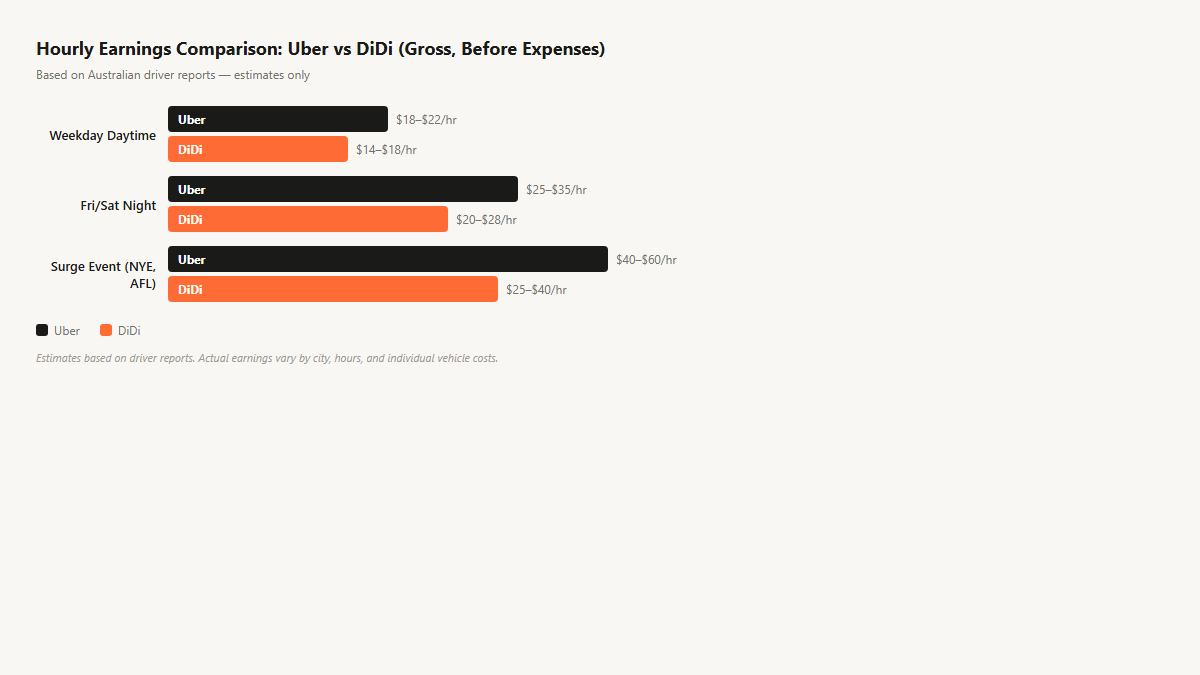
These figures come from driver reports on Australian forums and represent typical gross earnings before fuel and vehicle costs:
| Scenario | Uber Only | DiDi Only | Both Apps |
|---|---|---|---|
| Weekday daytime | $18–$22/hr | $14–$18/hr | $19–$23/hr |
| Friday/Saturday night | $25–$35/hr | $20–$28/hr | $28–$38/hr |
| Surge event (NYE, AFL) | $40–$60/hr | $25–$40/hr | $45–$65/hr |
The “Both Apps” column is the reason most serious full-time drivers multi-app. You’re accepting whichever platform sends a trip first — DiDi’s higher rate when it comes through, Uber’s consistent volume filling the gaps.
One counterintuitive finding from driver reports: on surge events like New Year’s Eve or AFL Grand Final nights, Uber’s surge multiplier often outpaces DiDi’s flat rate. On those specific nights, some drivers close DiDi and run Uber exclusively to capture the full surge.
Sign-Up Requirements: Are They Different?
The basics are the same. Both platforms require:
- A valid Australian driver’s licence (held at least 1 year)
- An ABN (Australian Business Number) — free to register at abr.gov.au
- GST registration with the ATO (mandatory from your first trip on either platform)
- A 4-door vehicle no more than 10 years old
- State-specific transport accreditation (required in all states for both platforms)
DiDi’s sign-up process tends to be slightly faster than Uber’s in practice — drivers report approval in 3–5 business days vs Uber’s 5–10 days. Both platforms run a national criminal history check before activation.
The vehicle inspection requirement is the same: annual, at an approved station, regardless of which platform you drive for. If your car is already Uber-approved, it’s DiDi-approved.
Driver Experience: App Quality and Support
This is where Uber wins clearly. The Uber Driver app is more polished, the in-app navigation is better integrated, and the earnings tracking is more detailed. DiDi’s app works — but it’s a step behind in user experience.
Neither platform offers phone support for Australian drivers. Both are in-app only, which is frustrating when something goes wrong. Based on driver reports, Uber’s in-app support resolves issues somewhat faster, though neither is what you’d call good.
DiDi’s ratings system is worth knowing: DiDi displays your rating less prominently to passengers, which some drivers feel leads to more generous ratings. Uber’s rating system is better known and passengers are more aware they’re rating you.
Which Platform Should You Choose?
There’s no single right answer — it depends on how you want to drive.
Sign up for Uber first if you’re just starting out. The trip volume means you’ll be earning straight away, and the app experience is better for learning how surge pricing works and where demand sits in your city.
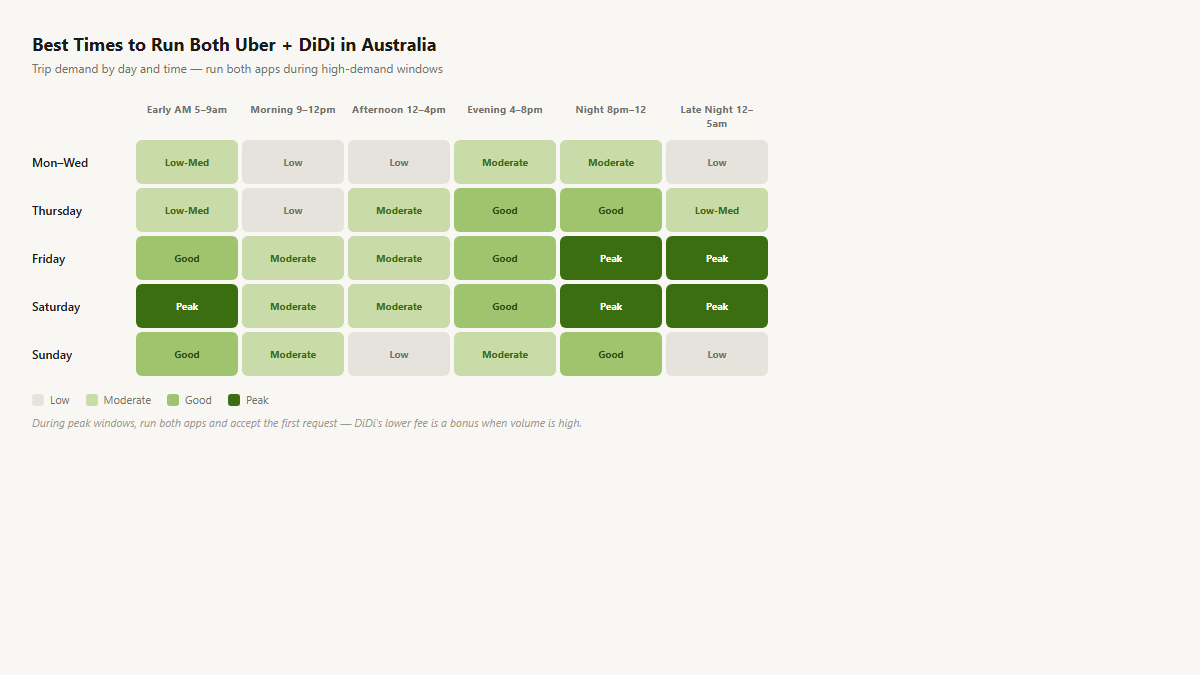
Add DiDi once you’re comfortable running the Uber app. The multi-app strategy — running both simultaneously and accepting whichever sends a request first — is how full-time drivers in Sydney and Melbourne squeeze 15–25% more income out of the same hours.
Skip DiDi for now if you’re in a smaller market like Gold Coast or Adelaide. The trip volume just isn’t there to make it worthwhile on typical days. Revisit it during major events when DiDi sometimes runs promotions to compete with Uber surge.
You can start your Uber driver application here #affiliate — the process takes around 15 minutes. If you want to add DiDi, you can start your DiDi driver application here #affiliate.
Practical Tips for Running Both Platforms
- Accept the first request that comes in, regardless of platform — dead time waiting costs more than DiDi’s rate advantage is worth
- Monitor DiDi’s promotions: DiDi regularly runs trip bonuses (e.g. earn $X extra for completing 20 trips this week) — these can tip the balance significantly in DiDi’s favour during promo periods
- Use two phone mounts if you’re serious about multi-apping — switching between apps mid-trip is distracting and sometimes against platform terms
- Keep separate records for each platform — your BAS and tax return need income broken down by platform
- Check DiDi’s driver app weekly even in slow periods — the promo calendar changes and you don’t want to miss a bonus week
Frequently Asked Questions
Can I drive for both Uber and DiDi at the same time in Australia?
Yes. There’s no exclusivity clause in either platform’s Australian driver agreement. Running both apps simultaneously and accepting whichever sends a request first is a common and completely legitimate strategy. Many full-time drivers in Sydney and Melbourne do this as standard practice.
Does driving for DiDi affect my Uber rating?
No. The platforms are entirely separate. Your DiDi rating exists only within DiDi, and your Uber rating exists only within Uber. A low rating on one doesn’t carry across to the other.
Do I need a separate ABN for DiDi?
No. Your ABN covers all your rideshare and gig economy activity. You register once as a sole trader and use the same ABN for Uber, DiDi, DoorDash, or any other platform. If you don’t have an ABN yet, you can apply free at abr.gov.au — it takes around 15 minutes and is issued instantly in most cases.
Last reviewed: 01/09/2026