Do Uber Drivers Pay GST in Australia? (ATO Rules Explained)
Last reviewed: September 2026
Yes — all Uber drivers in Australia must register for GST and pay it from their very first trip. The usual $75,000 annual turnover threshold that applies to most small businesses does not apply to rideshare drivers. This is one of the most misunderstood tax obligations in the gig economy, and getting it wrong can mean unexpected debt to the ATO.
How GST Works for Uber Drivers in Australia
GST (Goods and Services Tax) is a 10% tax on most goods and services sold in Australia. For most businesses, you only need to register once your annual turnover hits $75,000. Uber drivers are a specific exception to this rule.

Under Australian tax law, taxi travel — which includes all rideshare services — has its own GST rules. The ATO classifies Uber as a “ride-sourcing” service, and ride-sourcing is treated the same as taxi travel for tax purposes. That means the $75,000 threshold is irrelevant. You must register for GST before you drive your first paying passenger.
This rule has been in place since 2015, when the ATO ruled that services like Uber constituted taxi travel under the GST Act. It doesn’t matter if you drive two hours a week or forty.
What You’re Required to Do
Once you start driving for Uber, three GST obligations apply immediately.
Register for GST. You can do this for free through the Australian Business Register at abr.gov.au. Registration takes about 15 minutes and usually activates within a day. You’ll also need an ABN (Australian Business Number) to register — also free, also done at abr.gov.au, and usually issued instantly.
Charge GST on all fares. In practice, Uber handles this on your behalf. Your Uber earnings already include GST — the platform calculates it and the ATO is notified via the Sharing Economy Reporting Regime (SERR), which requires platforms like Uber to report all driver income directly to the ATO from 1 July 2023 onward. This means the ATO already knows what you’ve earned before you lodge anything.
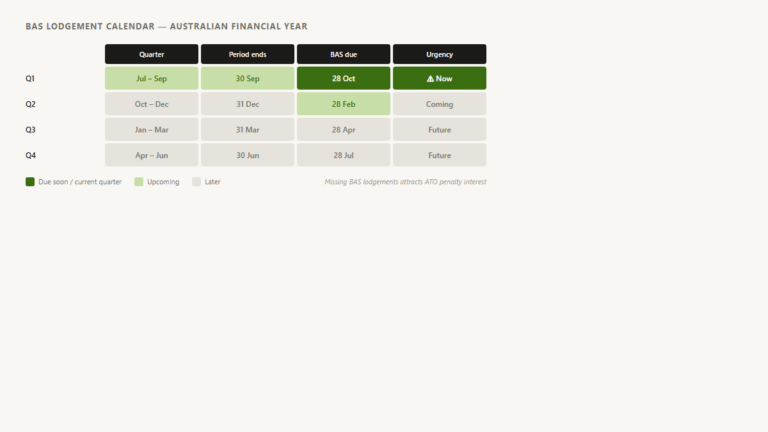
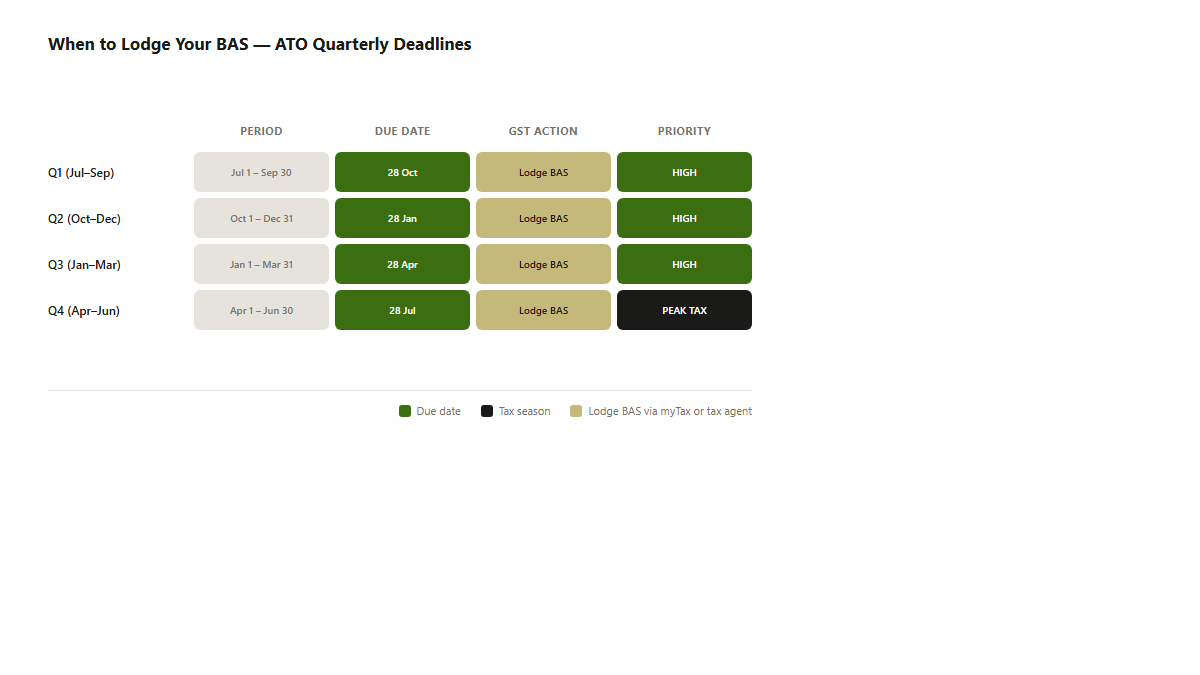
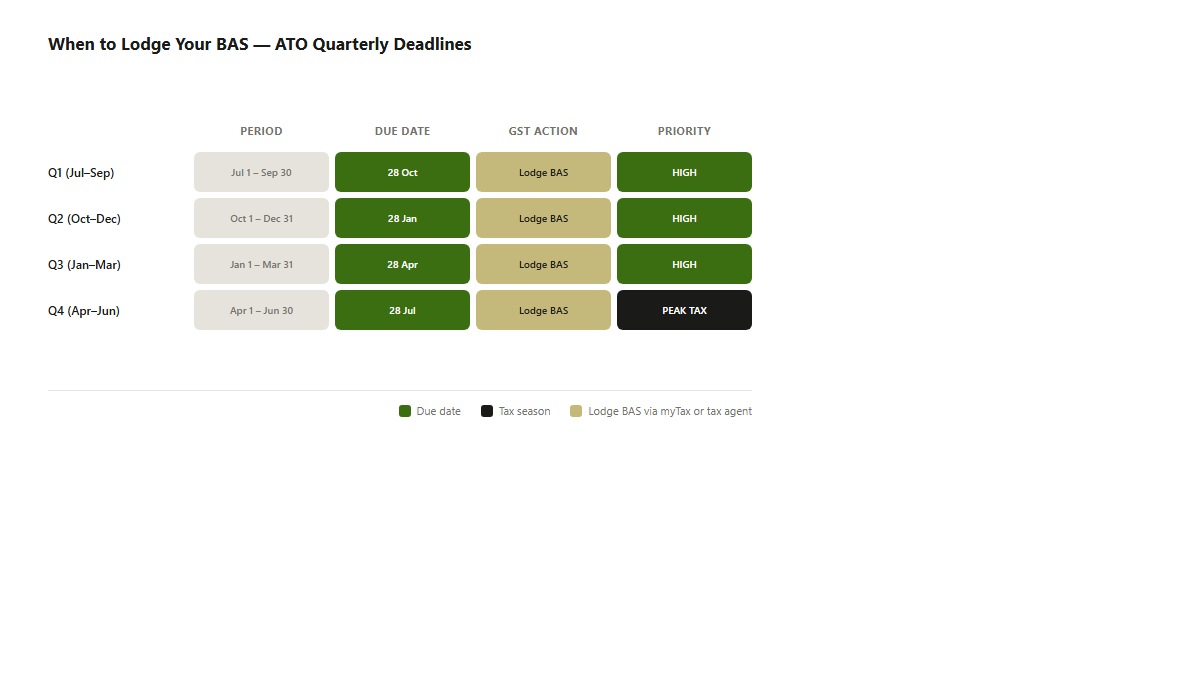
Lodge a BAS every quarter. A BAS (Business Activity Statement) is a quarterly report to the ATO where you declare the GST you’ve collected on fares and claim back the GST credits on your business expenses. BAS periods and due dates are:
| Quarter | Period | Due Date |
|---|---|---|
| Q1 | July – September | 28 October |
| Q2 | October – December | 28 January |
| Q3 | January – March | 28 April |
| Q4 | April – June | 28 July |
Missing a BAS due date can trigger penalties from the ATO, so these dates matter.
How the GST Maths Actually Works
Here’s a concrete example of how GST flows through your Uber income.
Say you earn $1,000 gross from fares in a quarter. Of that, $90.91 is GST (GST is calculated as 1/11 of the GST-inclusive amount). You owe that $90.91 to the ATO via your BAS.
But you also paid GST on your business expenses — fuel, car servicing, your phone plan (the business-use portion). These are GST credits you can claim back. If your claimable GST credits in that quarter total $30, your net GST payment is $90.91 minus $30 = $60.91 to the ATO.
This is why keeping receipts for all business expenses matters. Every fuel receipt, every mechanic invoice — they all contain GST credits that reduce what you owe.
The Sharing Economy Reporting Regime (SERR) — Why This Matters
From 1 July 2023, Uber and all major gig platforms are legally required to report every driver’s income directly to the ATO each year. This is the Sharing Economy Reporting Regime.
The practical implication: the ATO data-matches your Uber income against what you declare on your tax return. If the numbers don’t align, you’ll receive a letter. And the ATO is not lenient with rideshare income — it’s been a compliance priority since rideshare became mainstream in Australia.
If you haven’t registered for GST and have been driving, the ATO can assess you for unpaid GST going back to when you started, plus penalties and interest. The sooner you register, the smaller any backdating problem becomes.
What About Uber Eats and Food Delivery?
Food delivery drivers have different rules. Uber Eats, DoorDash, and Menulog delivery drivers are not automatically required to register for GST under the rideshare rule. The $75,000 threshold applies to food delivery because it doesn’t fall under the taxi travel definition.
But if you do both — rideshare driving and food delivery — you must register for GST because of the rideshare component. And once you’re registered, GST applies to all your gig income, including the food delivery earnings.
If your food delivery income alone exceeds $75,000 in a year, you’d also need to register — but this is rare for individual drivers.
Practical Tips for Managing GST as an Uber Driver
- Register before your first trip, not after. There’s no grace period, and backdating is painful.
- Set aside 10% of every payout in a separate savings account. This isn’t exactly what you’ll owe (GST credits reduce it), but it ensures you’re never short at BAS time.
- Use accounting software that connects to your bank — MYOB and Xero both have BAS lodgement features, and Driversnote automates your mileage tracking for the vehicle expense claims #affiliate.
- Lodge your BAS on time, every quarter. Late lodgement fees start at $222 and increase with each 28-day period of delay.
- Keep every receipt for business expenses — fuel, phone, car wash, accessories. The GST credits add up across a year.
- Lodge BAS through myTax or via a registered tax agent. If you use a tax agent, their lodgement deadlines are extended — a useful buffer.
Frequently Asked Questions
Do I need to register for GST before my first Uber trip?
Yes. The ATO requires rideshare drivers to register for GST before they start driving — not after. There’s no income threshold to hit first. Registration is free at abr.gov.au and takes about 15 minutes.
What happens if I’ve been driving Uber without registering for GST?
Register immediately. The ATO can back-date your GST liability to when you started driving, plus apply penalties and interest. The sooner you register, the less exposure you have. If you have significant unregistered earnings, speaking with a registered tax agent before contacting the ATO yourself is worthwhile.
Is GST 10% of everything I earn from Uber?
Not quite. GST is 1/11 of your GST-inclusive fare total — so on $1,100 in fares, $100 is GST. But you reduce what you owe by claiming GST credits on your business expenses. Most drivers end up paying less than the full 10% once credits are factored in.
—
This article is general information only and does not constitute tax advice. GST rules for rideshare drivers can change, and your individual circumstances may vary. We recommend speaking with a registered tax agent for advice specific to your situation. You can find a registered tax agent through the Tax Practitioners Board at tpb.gov.au.
Last reviewed: 01/09/2026