Uber Eats vs Menulog Driver Australia: Which Pays More?
This article contains affiliate links. If you sign up through our links, we may earn a commission at no extra cost to you. This does not influence our recommendations.
Uber Eats generally pays more per delivery than Menulog, but Menulog gives you a fixed fee per order rather than a distance-based rate — which can work in your favour on short, busy runs. Which one actually earns you more depends heavily on where you’re based, how far orders send you, and what hours you work.
Earnings estimates are based on driver reports and vary by city, hours worked, and individual expenses.
Uber Eats vs Menulog at a Glance
Before getting into the detail, here’s how the two platforms compare on the factors that matter most to drivers.
| Factor | Uber Eats | Menulog |
|---|---|---|
| Pay structure | Distance-based per delivery | Fixed fee per delivery |
| Estimated gross pay | $18–$25/hr | $15–$22/hr |
| Trip volume | High — market leader in AU | Moderate — smaller rider base |
| Surge pricing | Yes — dynamic boosts in busy periods | No — flat fee regardless of demand |
| Payment frequency | Weekly (Tuesdays) | Weekly |
| Vehicle types accepted | Bicycle, scooter, car | Bicycle, scooter, car, walking |
| App rating | Generally rated higher by drivers | Mixed — some city app issues reported |
| Sign-up bonus | Varies — check current offer | Varies — check current offer |
How Each Platform Pays Drivers
Uber Eats uses a distance-based model: each delivery earns a base amount plus a per-kilometre rate for the distance from restaurant to customer. On longer suburban runs, this can add up well. On short inner-city deliveries where restaurants and customers are close together, your per-delivery earnings shrink even though the effort is similar.
Menulog pays a flat fee per delivery. The exact amount varies by city and isn’t publicly disclosed, but drivers typically report receiving $7–$10 per order on average, regardless of distance. This works in your favour when you’re doing fast, back-to-back runs in a dense area. But if you end up driving 15 minutes to drop off a single burger, the same flat fee starts to hurt.
Uber Eats also has dynamic pricing boosts — equivalent to surge pricing — during peak periods. These can push your effective hourly rate well above the baseline. Menulog has no equivalent. What you see is what you get, regardless of whether it’s midnight on New Year’s Eve or Tuesday lunchtime.
Which Pays More per Hour?
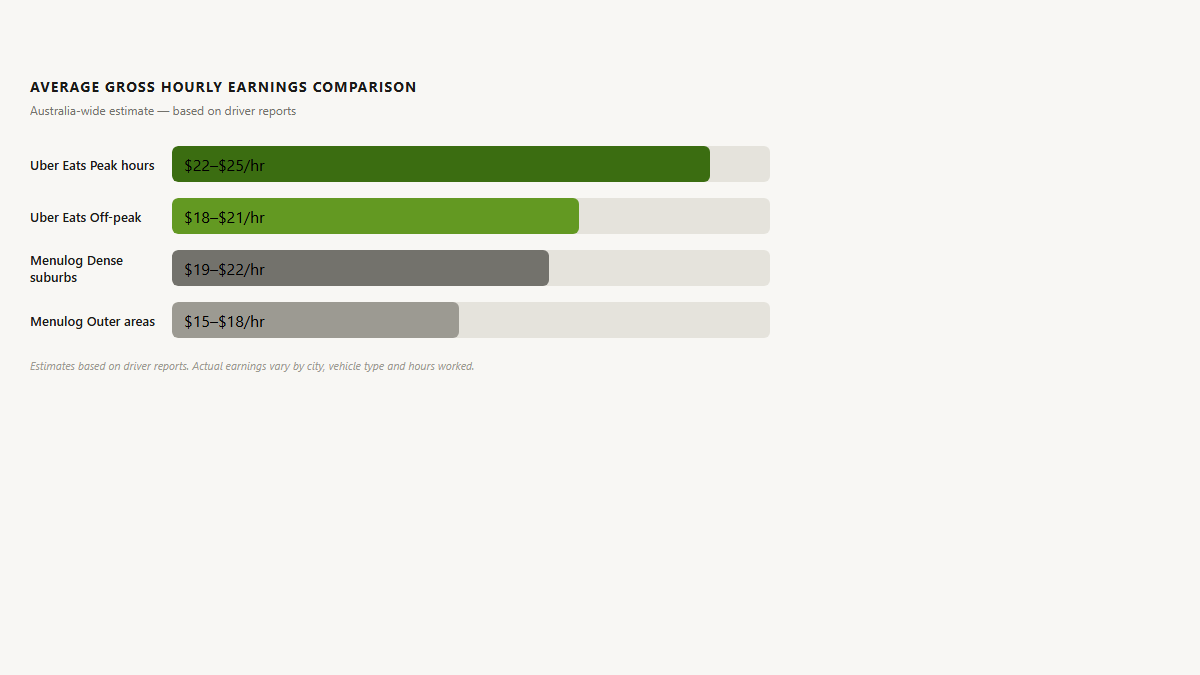
Based on driver reports across Sydney, Melbourne, and Brisbane, Uber Eats tends to produce higher hourly earnings for most driver types — but the gap narrows for drivers who work efficiently in dense suburban areas on Menulog.
For a driver doing 3–4 deliveries per hour:
- Uber Eats: Roughly $18–$25/hr gross (higher during boost periods, lower on slow evenings)
- Menulog: Roughly $15–$22/hr gross (more consistent, less variable)
The key variable is delivery density. In a suburb where restaurants and customers are clustered within 2–3km of each other, Menulog’s flat fee model can be surprisingly competitive because you’re completing more deliveries per hour. In outer suburbs where each run might involve 10–12km of driving, Uber Eats’ distance component generally wins.
Both platforms’ gross figures drop meaningfully once you account for fuel. A car driver covering 80–100km in a typical delivery shift will spend $15–$20 on petrol (at current national averages around $1.80–$2.00/L). Bicycle and scooter riders have a significant cost advantage here.
Trip Volume and Work Availability
Uber Eats has a larger customer base in Australia and consistently offers more orders per shift, particularly in major cities. If you log on at 6pm on a Friday in Melbourne or Sydney, you’re unlikely to be sitting idle for long.
Menulog’s order volume is noticeably lower. Drivers in smaller cities like Adelaide, Perth, or Canberra sometimes report extended waits between orders, especially during off-peak hours. This directly affects your hourly earnings — idle time is unpaid time.
But Menulog has one genuine advantage: less competition from other drivers. Fewer delivery drivers on the platform means the orders that do come in aren’t being fought over by dozens of people in the same zone.
Flexibility and Working Conditions
Both platforms let you log on and off whenever you want — there are no set shifts, no minimum hours, and no penalty for going offline. This is a genuine advantage of gig delivery work over traditional employment.
Uber Eats’ app is generally considered more polished and reliable. The navigation is cleaner, support contact (while still slow) is more accessible than Menulog’s, and disputed pay issues tend to get resolved faster.
Menulog’s app has had mixed reviews from drivers, particularly in smaller cities where technical glitches are more commonly reported. Some drivers have noted inconsistent order notifications and occasional double-booking of restaurants — where two drivers are sent to the same restaurant for the same order.
Both platforms require you to hold an ABN (Australian Business Number) and be registered as a sole trader. You’ll also need appropriate insurance for commercial delivery work — your standard comprehensive car policy won’t cover you while you’re earning on delivery platforms. Check with your insurer before your first shift.
Practical Tips for Delivery Drivers
- Run both apps at once. Nothing in Uber Eats’ or Menulog’s driver agreements prevents you from being active on both simultaneously. Accept whichever order comes first. Many high-earning delivery drivers do exactly this.
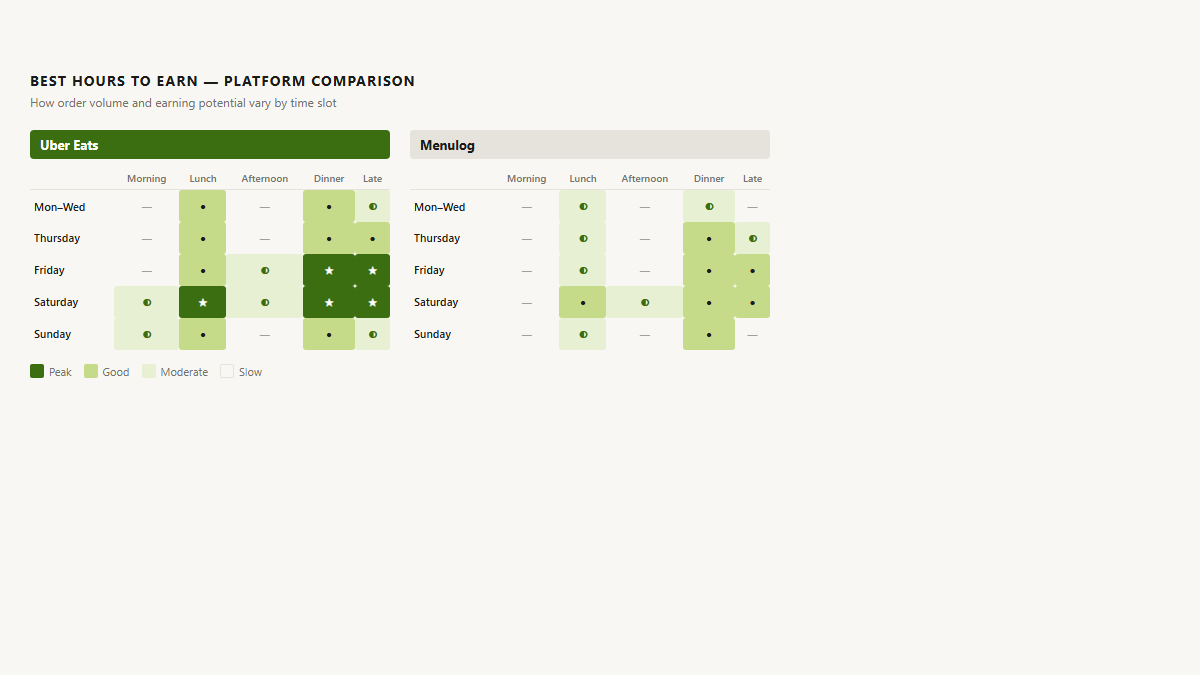
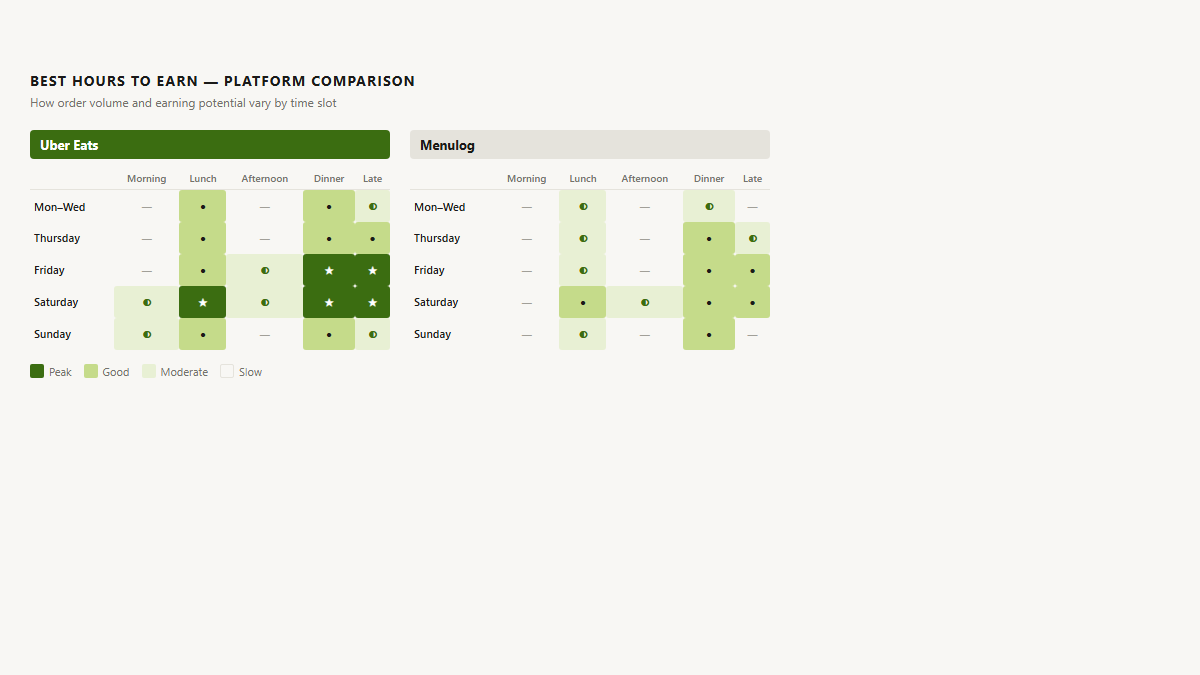
- Target Uber Eats during peak hours, Menulog during slow periods. When boosts are active on Uber Eats (Friday dinner, Saturday lunch), lean into it. When it’s quiet mid-afternoon, Menulog’s flat fee at least keeps you earning.
- In dense suburbs, favour Menulog. If you’re working an area where restaurants are concentrated within 2km of most customers, Menulog’s flat fee competes well.
- Track every kilometre. Both platforms report income to the ATO via the Sharing Economy Reporting Regime (SERR) from 1 July 2023 — every cent is visible to the tax office. Use an app like Driversnote to log business kilometres for your tax return.
- Check sign-up bonuses before committing. Both platforms periodically offer new driver bonuses for completing a set number of deliveries in your first weeks. The value varies, but it can add $100–$300 to your early earnings.
- Consider your vehicle type. Bicycle and scooter riders pay almost nothing in fuel costs, which dramatically improves net earnings on either platform — especially on short inner-city runs.
Frequently Asked Questions
Can I drive for both Uber Eats and Menulog at the same time in Australia?
Yes. There’s no exclusivity clause in either platform’s driver agreement. Most experienced delivery drivers run both apps simultaneously and accept whichever order arrives first. Just make sure you don’t accept an order on one platform while already committed to a pickup on the other.
Does Menulog pay better than Uber Eats in Australia?
Generally no — Uber Eats tends to produce higher hourly earnings for most drivers, particularly in major cities and during peak periods when boosts apply. Menulog’s flat-fee model can be competitive for drivers working dense suburban areas with short delivery distances, but for most drivers most of the time, Uber Eats pays more.
Do food delivery drivers pay GST in Australia?
Food delivery drivers (as opposed to rideshare drivers) are subject to the standard GST threshold — you only need to register for GST if your turnover exceeds $75,000 per financial year. This is different from rideshare, where GST registration is mandatory from your first trip. That said, you still need an ABN, and all your income is taxable. See our [Uber driver tax guide for Australia] for a full explanation of your tax obligations.
—
This article is general information only and does not constitute tax or financial advice. For advice specific to your situation, speak with a registered tax agent. You can find one at tpb.gov.au.
Ready to sign up? You can start your Uber Eats driver application here #affiliate — the process takes around 15 minutes and most drivers are approved within 2–3 business days.
Last reviewed: 01/09/2026