How Much Do Uber Drivers Make in Australia? (Honest Numbers)

This article contains affiliate links. If you sign up through our links, we may earn a commission at no extra cost to you. This does not influence our recommendations — we only link to platforms we’d genuinely recommend to Australian drivers.
Earnings estimates are based on driver reports and publicly available research. Actual figures vary significantly depending on your city, hours worked, and individual expenses.
Most Uber drivers in Australia earn between $20 and $30 per hour gross — before fuel, vehicle wear, and tax. After those costs, the realistic net figure sits closer to $12–$20 per hour. What you actually take home depends heavily on where you drive, when you drive, and how efficiently you manage your expenses.
How Much Australian Uber Drivers Actually Earn
The split between gross and net earnings is where most guides get it wrong. They quote the gross figure — what Uber pays you — and forget to mention that roughly a third of it vanishes before you can spend it.
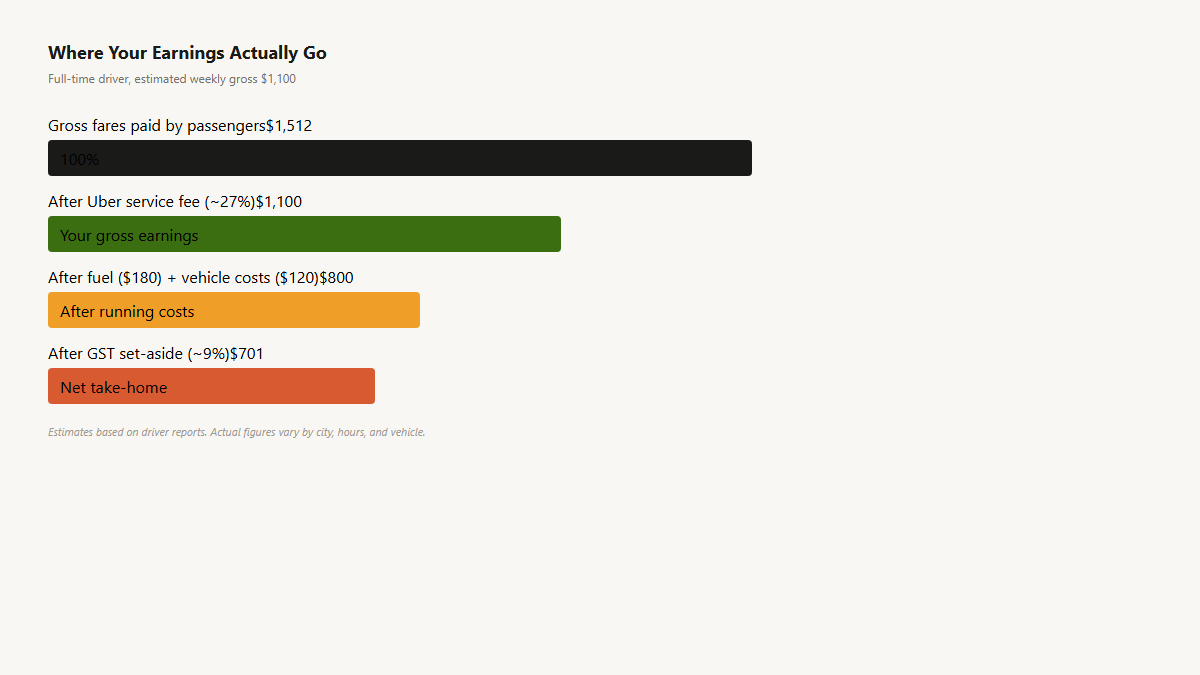
Here’s a realistic breakdown by commitment level, based on driver reports from Australian rideshare forums and publicly cited research:
| Driving Style | Weekly Hours | Gross/Week (Est.) | Net/Week (Est.) |
|---|---|---|---|
| Casual (side income) | 8–12 hrs | $160–$360 | $95–$215 |
| Part-time | 20–25 hrs | $400–$750 | $240–$450 |
| Full-time | 40–50 hrs | $800–$1,500 | $480–$900 |
Full-time drivers at the higher end are typically working peak periods — Friday and Saturday nights, New Year’s Eve, major events — and running an efficient route strategy. Casual drivers doing a few hours on weekday evenings will sit closer to the lower figures.
What Eats Into Your Gross Income
Uber takes approximately 25–27.5% of every fare as its service fee. That comes off the top before you see a dollar. What’s left is your gross driver earnings — and that’s the number most guides quote.

But your actual costs don’t stop there:
- Fuel — the biggest variable. At current national averages of $1.70–$2.20/litre, a full-time driver covering 1,000+ kilometres a week can spend $150–$250 on fuel alone.
- Vehicle depreciation and maintenance — budget roughly $0.15–$0.25 per kilometre for tyres, servicing, and the accelerated wear that comes with rideshare driving.
- GST — all rideshare drivers must register for GST from their very first trip. You collect 1/11th of your fares on behalf of the ATO and remit it quarterly. This effectively reduces your take-home by around 9%.
- Dead kilometres — time spent repositioning without a fare. In quieter cities or off-peak periods, dead kilometres can represent 20–30% of total distance driven.
City-by-City Earnings Comparison
Where you drive matters more than most new drivers expect. Sydney and Melbourne consistently produce the highest earnings — more demand, more surge pricing, and higher base fares than smaller markets.
| City | Gross Hourly (Est.) | Peak Multiplier | Best Periods |
|---|---|---|---|
| Sydney | $22–$30 | 1.5–3x | Fri–Sat nights, NYE, major events |
| Melbourne | $20–$28 | 1.5–2.5x | Fri–Sat nights, AFL Finals, Grand Prix |
| Brisbane | $18–$25 | 1.3–2x | Fri–Sat nights, Schoolies, festivals |
| Perth | $17–$24 | 1.3–2x | Fri–Sat nights, isolated market |
| Adelaide | $15–$22 | 1.2–1.8x | Fri–Sat nights, Fringe Festival, WOMADelaide |
| Gold Coast | $17–$25 | 1.5–2.5x | Tourist season, summer, major events |
Sydney’s AlphaBeta research — cited by multiple industry sources — put average gross earnings at roughly $29/hr with net around $21/hr for active drivers. Those figures align with what experienced Sydney drivers report, though newer drivers and those working off-peak will see lower numbers.
What the Tax Obligations Mean for Your Take-Home
This is the part most income guides skip entirely, and it’s the part that catches new drivers off guard.
GST registration is mandatory from your first trip — unlike most sole traders, you don’t get to wait until you earn $75,000. This means you’ll need an ABN (Australian Business Number), a quarterly BAS (Business Activity Statement), and a basic system for tracking your income and expenses.
The good news is that you can also claim GST credits on business expenses — fuel, vehicle costs, phone, accessories — which reduces your actual GST bill. And you can deduct those same expenses from your taxable income at tax time.
But you need to keep records to claim them. If you’re just pocketing what Uber pays you and not tracking kilometres or expenses, you’re overpaying the ATO.
For a plain-English guide to exactly what you owe and what you can claim, see our article on [Uber driver tax in Australia].
This section is general information only. For advice specific to your situation, speak with a registered tax agent. You can find one at tpb.gov.au.
Practical Tips to Maximise Your Uber Earnings
- Work Friday and Saturday nights — consistently the highest-earning windows in every Australian city. Two good nights can match or exceed what a casual driver earns across an entire week of off-peak shifts.
- Learn your city’s surge hotspots — nightlife precincts, train stations after last service, sports stadiums at the final siren. Positioning yourself near high-demand areas before surge hits is far more effective than chasing the heat map after the fact.
- Track every kilometre — a logbook or mileage app turns your fuel and vehicle costs into real tax deductions. Full-time drivers using the logbook method commonly claim $10,000–$20,000 in vehicle deductions annually.
- Know your dead kilometre rate — if more than 20–25% of your distance is unoccupied, your effective earnings are lower than the hourly figures suggest. Airport queues are a classic trap — long waits for a single fare rarely justify the time.
- Factor in vehicle age and reliability — the economics change significantly once you’re driving a car with higher maintenance costs. A reliable, fuel-efficient vehicle is one of the biggest levers on your net income.
- Consider DiDi alongside Uber — DiDi operates in Sydney, Melbourne, Brisbane, Perth, Adelaide, and the Gold Coast. Running both apps and accepting whichever trip arrives first is a straightforward way to reduce dead time between fares.
Frequently Asked Questions
How much do Uber drivers make per hour in Australia after expenses?
After fuel, vehicle costs, and GST obligations, most Australian Uber drivers net $12–$20 per hour. The exact figure depends on your city, which hours you work, and how efficiently you manage your vehicle costs. Full-time drivers in Sydney or Melbourne who work peak periods consistently can reach the upper end of that range.
Is $1,000 a week achievable driving Uber in Australia?
Yes, but it requires full-time hours and smart scheduling. To gross $1,000 in a week, you’d typically need 40–50 hours on the road, with a meaningful proportion of those hours during peak surge periods — Friday and Saturday nights, major events, school formals. After costs, $1,000 gross translates to roughly $600–$700 net. It’s achievable, but it’s not a part-time outcome.
Do Uber drivers get paid weekly in Australia?
Yes — Uber pays Australian drivers weekly, every Tuesday, for all trips completed in the previous Monday-to-Sunday period. Payment is via direct bank transfer to your registered Australian bank account.
—
Ready to sign up? You can start your Uber driver application here #affiliate — the process takes around 15 minutes and most drivers are approved within a few business days.
Last reviewed: 01/09/2026